

Why do tables wobble? A guide to fixing a wobbly table for good
1. Why is a four-legged table unstable?
In geometry, three points always define a plane. A four-legged table needs the fourth point to lie on that same plane too. If the floor differs in height by even a millimeter, the table stands on two diagonal legs and rocks toward whichever side you press. The problem is usually caused less by the table's quality than by the mismatch between the floor and the table.
2. The 5 most common causes of table wobble
- Sloped outdoor floors: Terraces and gardens are deliberately sloped so rainwater can drain.
- Jointed stone and tiles: Joints in paving, natural stone and ceramic tiles let a foot land in a gap.
- Gaps in wooden decking: Gaps between boards and flex over time upset the balance.
- Manufacturing tolerances: Small differences in leg length can cause wobbling even on a flat floor.
- Frequent moving: In cafés and restaurants, tables are rearranged every day, so a one-time adjustment never lasts.
3. Why don't temporary fixes work?
- Folded napkins or cardboard: Lost the first time the table is moved, and they look untidy to guests.
- Plastic shims and felt pads: Fixed thickness that can't match joints of different depths.
- Adjustable glides: They work when set correctly, but need re-adjusting every time the table moves, and outdoors the threads seize over time.
4. The permanent fix: a wobble-free table base
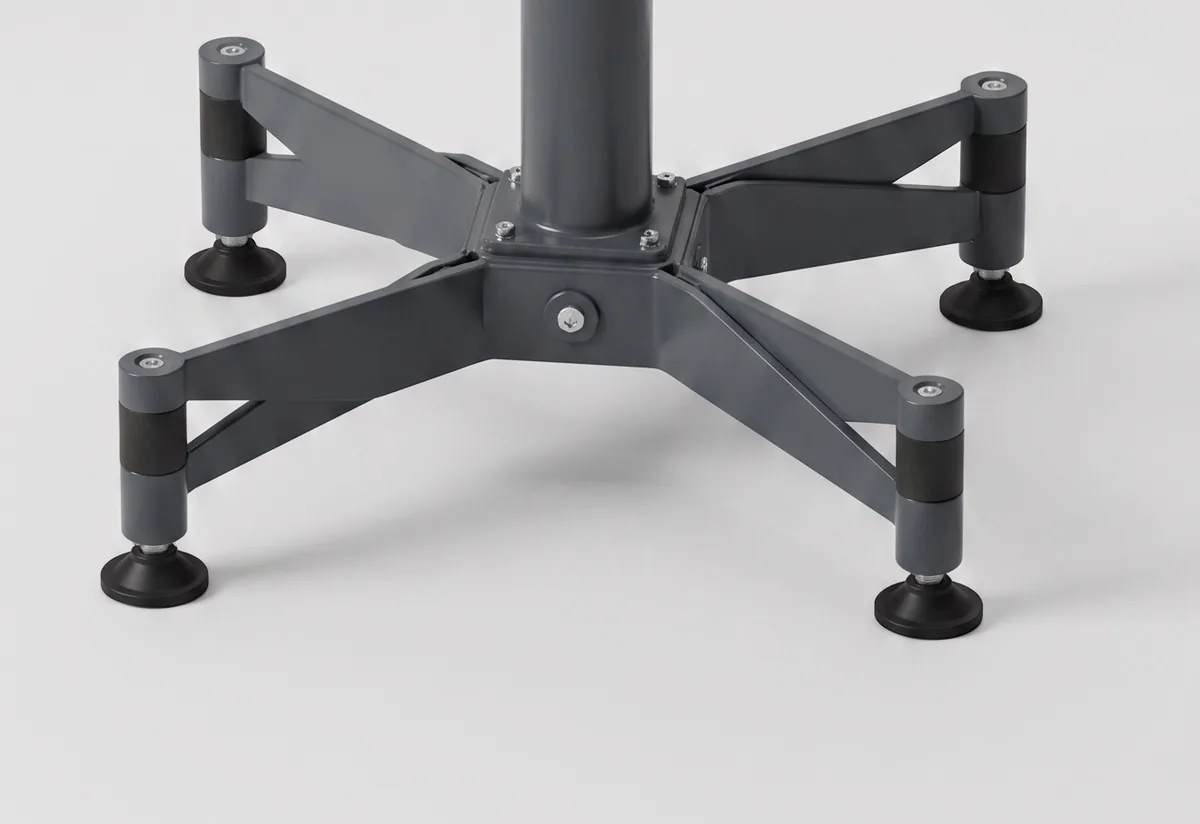
A wobble-free table base is designed so that its contact points adapt to differences in the floor by themselves. Belavi Wobble-Free Table Base, with its center-pivot cross base, lets the table sit on all four points the moment it is set down: the arms position themselves around the central pivot pin to follow the slope, and rubber joints at the arm ends absorb vibration. No re-adjustment is needed when the table is moved.
| Height | 74 cm |
|---|---|
| Base span | 43 cm |
| Top plate | 22 cm |
| Weight | ~9 kg (without top) |
| Finish | Electrostatic oven-cured powder coating; anthracite, black, green, mink or custom RAL |
5. What to look for in a wobble-free table
- Self-adjustment: It should have a pivoting base that needs no manual adjustment each time the table is moved.
- Base span: A wide base (e.g. 43 cm) gives confidence against tipping.
- Outdoor durability: Electrostatic powder coating and the right choice of steel matter for corrosion resistance.
- Fits existing tops: A standard top plate should let you replace the bases without replacing your tops.
- Supply capacity: Chains should choose a manufacturer that can supply the same product to every branch on time.
Conclusion
Table wobble is a floor problem, and the right fix is a base that adapts to the floor. Contact us for a wholesale quote on wobble-free table bases for cafés, restaurants and hotels.